Asian Pilates Flow:
15-Minute Beginner Balance Workout for Stability and Calm
Improve Balance, Build Confidence and Move with Greater Control
By Lilla Fonyo — Healthy Lifestyle & Longevity Writer
June 2026
Quick Summary
This Asian Pilates Flow routine is designed for beginners who are ready for the next step after learning the basics. Combining gentle Pilates movements with Tai Chi-inspired balance exercises, yoga-inspired mobility work, and mindful breathing, this 15-minute workout helps improve stability, coordination, posture, and body awareness.
The focus is not on intensity or perfection. Instead, you'll learn how to move with greater control, strengthen your core, and develop better balance in a calm and accessible way.
No equipment is required, and most exercises can be adapted to suit your fitness level.
Related Articles:
Asian Pilates Stress Relief Flow: Calm Mind & Body - Relax with this Asian Pilates stress relief flow. Gentle moves to calm your mind, reduce tension and restore balance.
Asian Pilates Beginner Flow: A Gentle, Flexible Way to Move, Breathe and Feel Better - Try a gentle Asian Pilates routine for beginners. Improve strength, mobility and relaxation with this simple 10-minute flow.
Asian Pilates: The Gentle Fitness Trend for Strength and Calm - Discover Asian Pilates — a mindful blend of classical Pilates, Tai Chi, and yoga that builds strength, balance, and inner calm.
Pilates Mental Health Benefits: Reduce Stress, Sleep Better - Discover how Pilates boosts mood, reduces stress, improves sleep and supports mental wellbeing through gentle, mindful movement.
Low-Impact Exercise - Gentle Movement That Still Gets Results - Discover the benefits of low-impact exercise and how gentle workouts can improve strength, mobility, mood and long-term health.
Tai Chi: A Gentle Low-Impact Exercise for Body and Mind - Discover the benefits of Tai Chi, a low-impact exercise that improves balance, reduces stress and supports physical and mental health.
🌿 Why Focus on Balance?
Balance is something many of us take for granted until it starts to decline.
Good balance helps with:
- Everyday movement and confidence
- Posture and alignment
- Core strength and stability
- Coordination and body awareness
- Reducing the risk of trips and falls
- Moving more efficiently during exercise
In Asian Pilates Flow, balance isn't about standing on one leg for as long as possible. It's about learning how your body moves, how your muscles work together, and how your breathing supports every movement.
This routine combines the controlled strength of Pilates with gentle influences from Tai Chi and yoga to create a balanced, flowing experience.
15-Minute Asian Pilates Beginner Balance Workout
Move slowly, breathe naturally, and focus on control rather than speed.
If any movement feels uncomfortable, reduce the range of motion or take a short rest.
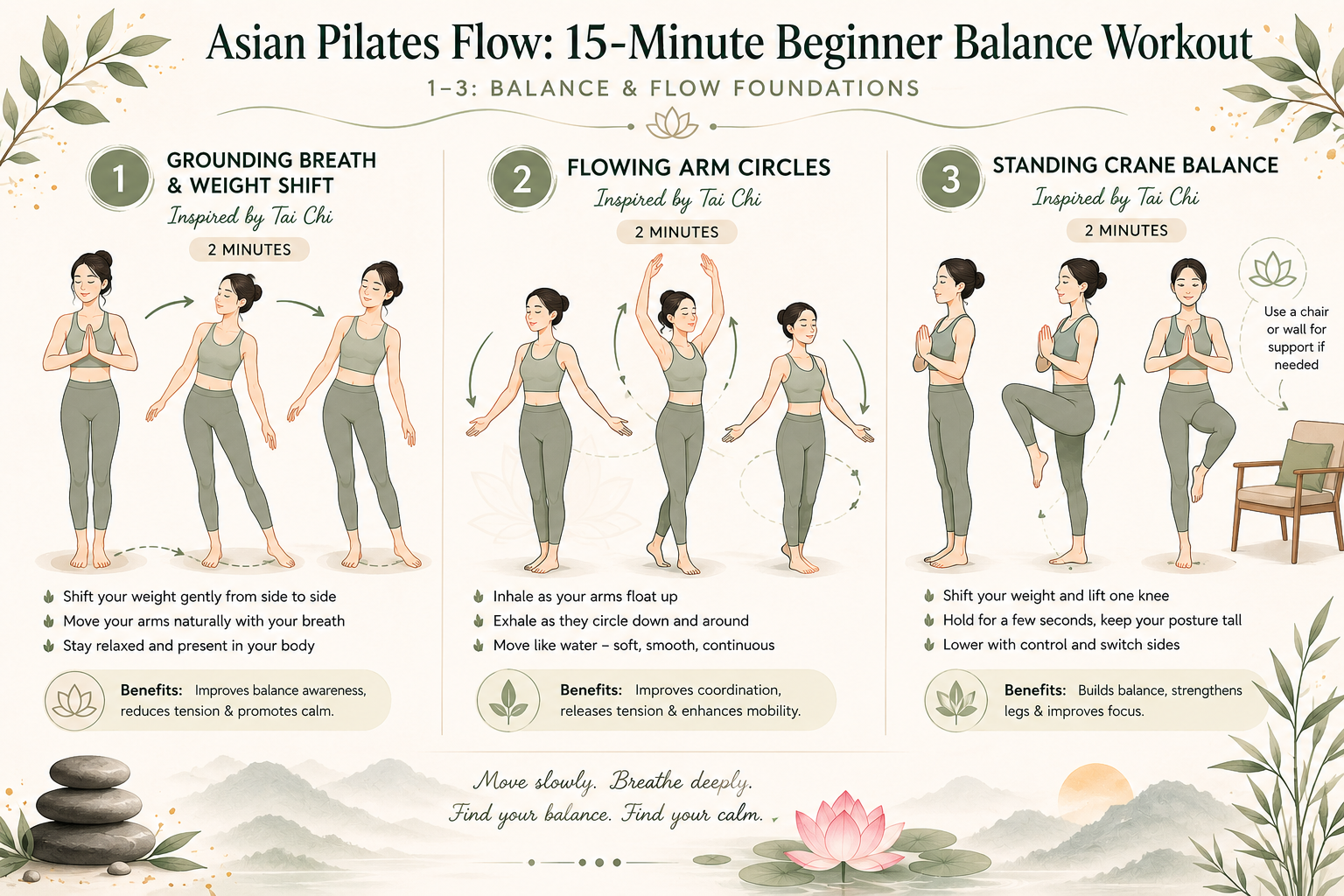
1. Grounding Breath and Weight Shift (2 Minutes)
Inspired by Tai Chi
Begin standing with your feet hip-width apart.
- Stand tall with relaxed shoulders.
- Inhale slowly through your nose.
- As you exhale, gently shift your weight onto your right foot.
- Inhale back to centre.
- Exhale and shift onto your left foot.
Allow your arms to move naturally with the flow of your body.
This simple exercise helps improve body awareness while encouraging calm, mindful movement.
Benefits:
- Improves balance awareness
- Encourages relaxation
- Helps prepare the body for movement
2. Flowing Arm Circles (2 Minutes)
Inspired by Tai Chi
Continue standing comfortably.
- Inhale as your arms float upwards.
- Exhale as they gently circle back down.
- Imagine moving through water.
- Keep your movements soft and continuous.
Avoid locking your joints or rushing.
Benefits:
- Improves coordination
- Releases shoulder tension
- Encourages smooth movement patterns
3. Standing Crane Balance (2 Minutes)
Inspired by Tai Chi's "Golden Rooster Stands on One Leg"
Stand near a wall or chair if needed.
- Shift your weight onto one foot.
- Slowly lift the opposite knee.
- Hold for a few seconds.
- Lower with control.
- Repeat on the other side.
Focus on keeping your posture tall rather than lifting the knee high.
Benefits:
- Improves balance and stability
- Strengthens supporting leg muscles
- Develops concentration and control
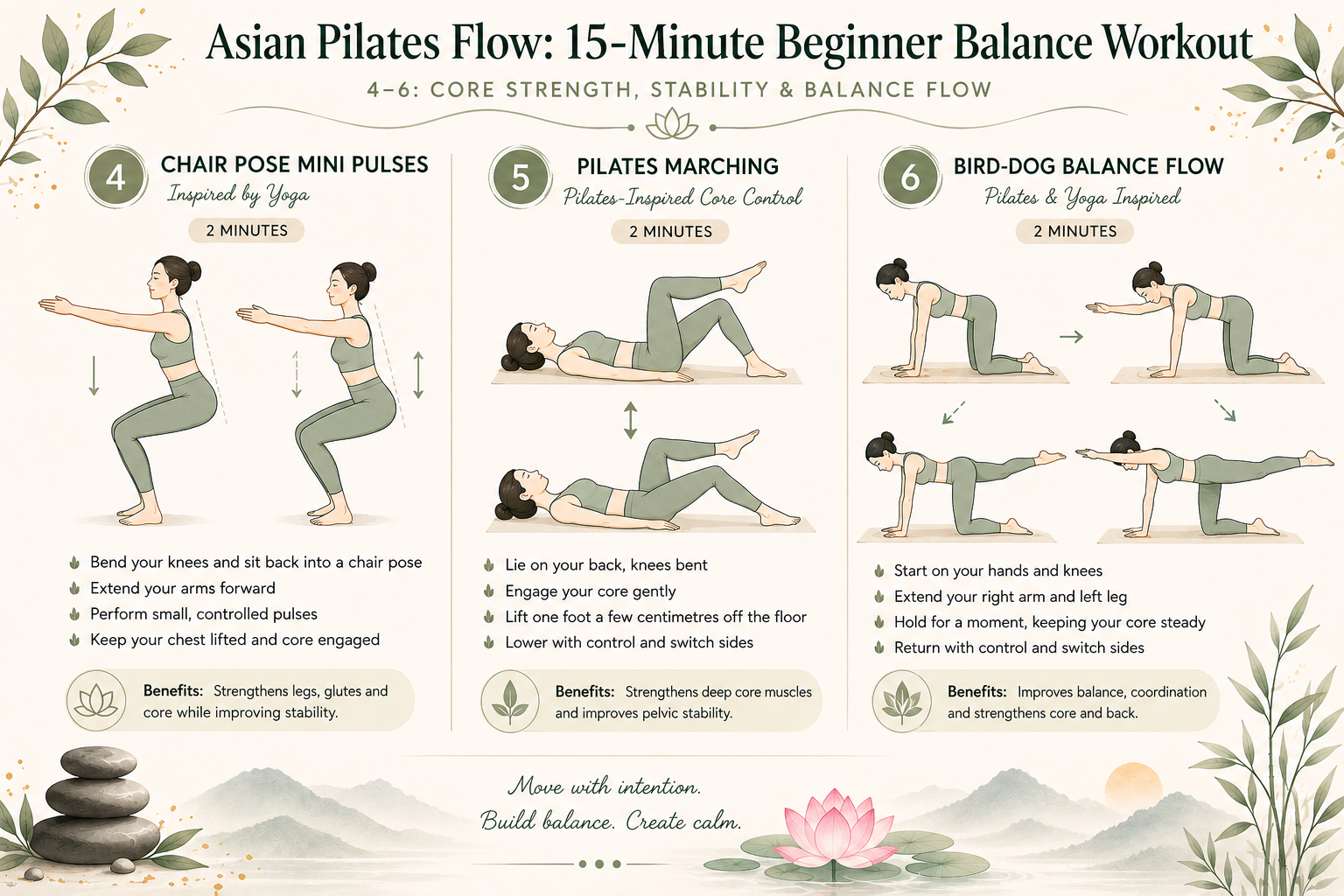
4. Chair Pose Mini Pulses (2 Minutes)
Inspired by Yoga
Stand with feet hip-width apart.
- Bend your knees slightly as if sitting back into a chair.
- Raise your arms comfortably in front of you.
- Hold briefly.
- Perform small controlled pulses.
Keep your chest lifted and avoid rounding your back.
Benefits:
- Strengthens legs and glutes
- Improves postural endurance
- Builds stability around the hips and knees
5. Pilates Marching (2 Minutes)
Pilates-Inspired Core Control
Lie on your back with knees bent and feet flat on the floor.
- Engage your abdominal muscles gently.
- Lift one foot a few centimetres from the floor.
- Lower slowly.
- Repeat on the opposite side.
Move with control rather than speed.
Benefits:
- Strengthens the deep core muscles
- Improves pelvic stability
- Supports better balance during standing exercises
6. Bird-Dog Balance Flow (2 Minutes)
Pilates and Yoga Inspired
Begin on your hands and knees.
- Extend your right arm forward.
- Extend your left leg behind you.
- Hold briefly.
- Return with control.
- Repeat on the opposite side.
Imagine reaching long rather than lifting high.
Benefits:
- Improves balance and coordination
- Strengthens the core and back
- Encourages full-body stability
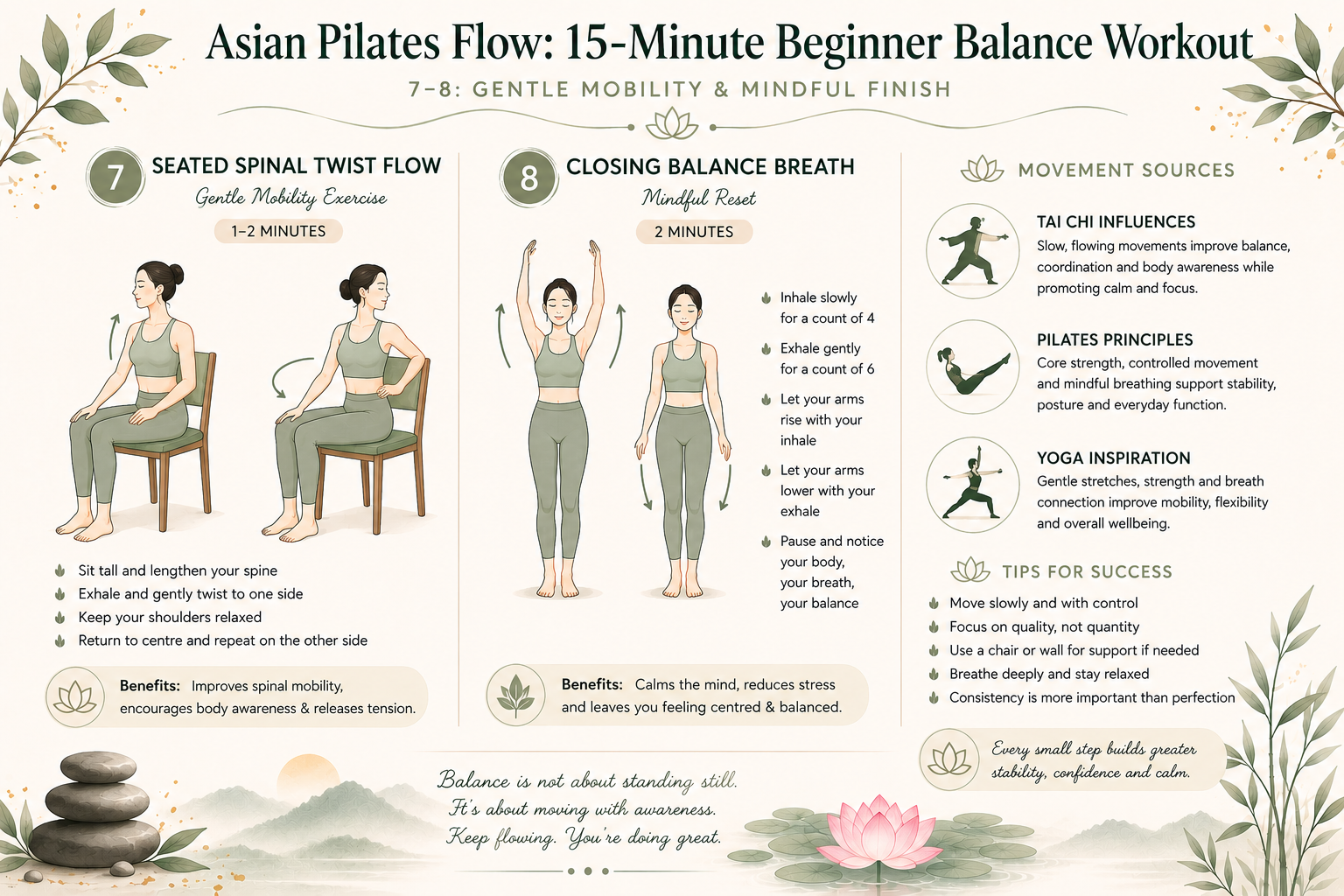
7. Seated Spinal Twist Flow (1–2 Minutes)
Gentle Mobility Exercise
Sit comfortably on a chair or the floor.
- Inhale to lengthen your spine.
- Exhale and gently rotate to one side.
- Return to centre.
- Repeat on the opposite side.
Keep the movement comfortable and relaxed.
Benefits:
- Improves spinal mobility
- Encourages body awareness
- Helps release tension after balance work
8. Closing Balance Breath (2 Minutes)
Finish standing or seated.
- Inhale slowly for a count of four.
- Exhale for a count of six.
- Allow your arms to rise gently with the inhale and lower with the exhale.
Take a moment to notice:
- Your posture
- Your breathing
- Your sense of stability
The goal is not to feel exhausted, but centred, calm, and more connected to your body.
How Tai Chi and Yoga Influence This Workout
One of the unique features of Asian Pilates Flow is its flexibility.
Rather than following a strict exercise system, it blends useful elements from different movement traditions.
Tai Chi Influences
Tai Chi is known for slow, controlled movements that promote balance, coordination, and body awareness.
In this workout, Tai Chi-inspired exercises include:
- Weight shifting
- Flowing arm circles
- Standing Crane Balance
These movements encourage stability while helping the body move more fluidly.
Yoga Influences
Yoga often combines mobility, balance, and mindful breathing.
In this routine, yoga-inspired elements include:
- Chair Pose Mini Pulses
- Controlled breathing
- Gentle spinal mobility work
Together with Pilates principles, these exercises create a balanced and accessible workout suitable for many beginners.
What Do Experts Say? (PubMed & NHS)
Although Asian Pilates Flow is a modern blended approach, many of its individual components are supported by research.
Findings from PubMed
Research published through PubMed suggests that Pilates-based exercise may help:
- Improve balance and postural control
- Enhance core strength
- Support mobility and flexibility
- Improve body awareness and movement confidence
Studies involving Tai Chi have also found benefits for balance, coordination, and fall prevention, particularly among older adults.
NHS Guidance
The NHS highlights the importance of regular physical activity for maintaining strength, balance, flexibility, and overall wellbeing.
The NHS also recognises that activities involving controlled movement and balance training can support healthy ageing, confidence in movement, and everyday function.
The Asian Pilates Flow Beginner Balance Workout is a natural next step after learning the basics.
By combining Pilates core control, Tai Chi-inspired balance exercises, yoga-inspired mobility, and mindful breathing, this routine helps you develop greater stability, confidence, and body awareness without high-impact exercise.
Remember that balance is a skill that improves gradually. Practising these movements regularly can help you move with greater ease, better posture, and a stronger connection between mind and body.
⚠️ Safety Note
Always move within your own comfort range and avoid any movement that causes pain.
If you have a medical condition, injury, dizziness, balance concerns, or are unsure whether a particular exercise is suitable for you, consult a qualified healthcare professional before beginning a new exercise programme.
❓ FAQ: Asian Pilates Flow: 15-Minute Beginner Balance Workout
Is this workout suitable for complete beginners?
Yes. It has been designed specifically for beginners and uses simple, low-impact movements that can be modified as needed.
How is this different from the Asian Pilates Beginner Flow?
The Beginner Flow focuses on introducing the basics. This workout builds on those foundations by adding more balance, coordination, and stability exercises.
Do I need any equipment?
No equipment is required. However, you may wish to use a chair or wall for support during balance exercises.
How often should I practise this routine?
Two to four sessions per week is a good starting point. Consistency is usually more important than duration.
Can balance exercises help improve posture?
Yes. Better balance often develops alongside improved core strength, coordination, and postural awareness.
Is the Standing Crane Balance difficult?
Not at all. Beginners can keep one foot lightly touching the floor or use a chair for support.
Is Asian Pilates Flow the same as Tai Chi?
No. Asian Pilates Flow combines elements of Pilates, Tai Chi, yoga, breathing exercises, and mindful movement into a flexible approach.
Can older adults try this workout?
Many of the exercises are suitable for older adults, but anyone with balance concerns should work within their comfort level and seek professional guidance if necessary.
This content is for educational purposes and does not replace medical advice…
Some useful links:
30 min beginner Pilates workout
20 min full body Pilates workout
28-day Asian Pilates Challenge
BOOK: Ariel Qiren Chen:
About the author
Lilla Fonyo is a healthy lifestyle and longevity writer with a background in endurance running, nutrition, and mindful living. She focuses on sustainable habits that support long-term physical and mental wellbeing.
Sources:
www.nhs.uk - Benefits of exercise
www.pubmed.ncbi.nlm.nih.gov - Effects of Pilates on Body Posture: A Systematic Review
www.health.harvard.edu - The health benefits of tai chi
www.who.int - WHO guidelines on physical activity and sedentary behaviour