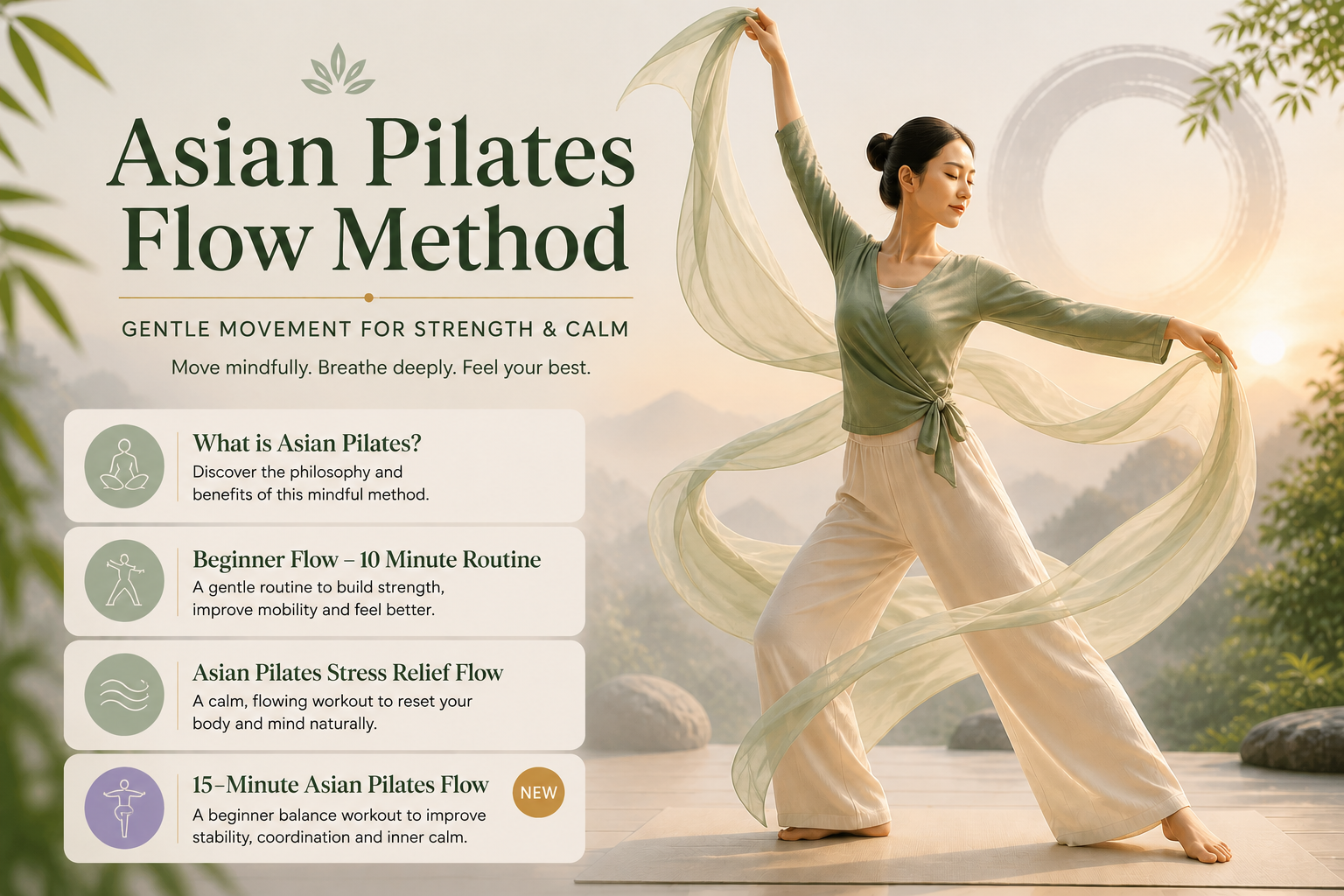
Asian Pilates Stress Relief Flow
A Calm, Flowing Workout to Reset Your Body and Mind Naturally
By Lilla Fonyo — Healthy Lifestyle & Longevity Writer
May 2026
Quick Summary
The Asian Pilates Stress Relief Flow is a gentle, calming routine designed to release tension, slow the mind, and restore balance. Blending elements of Pilates, Tai Chi, yoga, and breathwork, this sequence focuses on smooth, continuous movement and deep, mindful breathing.
It’s ideal for reducing stress, improving body awareness, and helping you feel more grounded—whether you have 10 minutes or a little longer.
Related Articles:
Asian Pilates Beginner Flow: A Gentle, Flexible Way to Move, Breathe and Feel Better - Try a gentle Asian Pilates routine for beginners. Improve strength, mobility and relaxation with this simple 10-minute flow.
Asian Pilates: The Gentle Fitness Trend for Strength and Calm - Discover Asian Pilates — a mindful blend of classical Pilates, Tai Chi, and yoga that builds strength, balance, and inner calm.
Pilates Mental Health Benefits: Reduce Stress, Sleep Better - Discover how Pilates boosts mood, reduces stress, improves sleep and supports mental wellbeing through gentle, mindful movement.
Low-Impact Exercise - Gentle Movement That Still Gets Results - Discover the benefits of low-impact exercise and how gentle workouts can improve strength, mobility, mood and long-term health.
Tai Chi: A Gentle Low-Impact Exercise for Body and Mind - Discover the benefits of Tai Chi, a low-impact exercise that improves balance, reduces stress and supports physical and mental health.
🌿 Why a Stress Relief Flow?
While your beginner routine builds awareness and strength, this next step focuses more deeply on nervous system regulation and emotional calm.
This flow is slower, softer, and more continuous—almost like a moving meditation.
Think:
- Less effort, more ease
- Less structure, more flow
- Less tension, more release
Asian Pilates Stress Relief Flow (10–15 Minutes)
Find a quiet space, move slowly, and let your breath guide you.
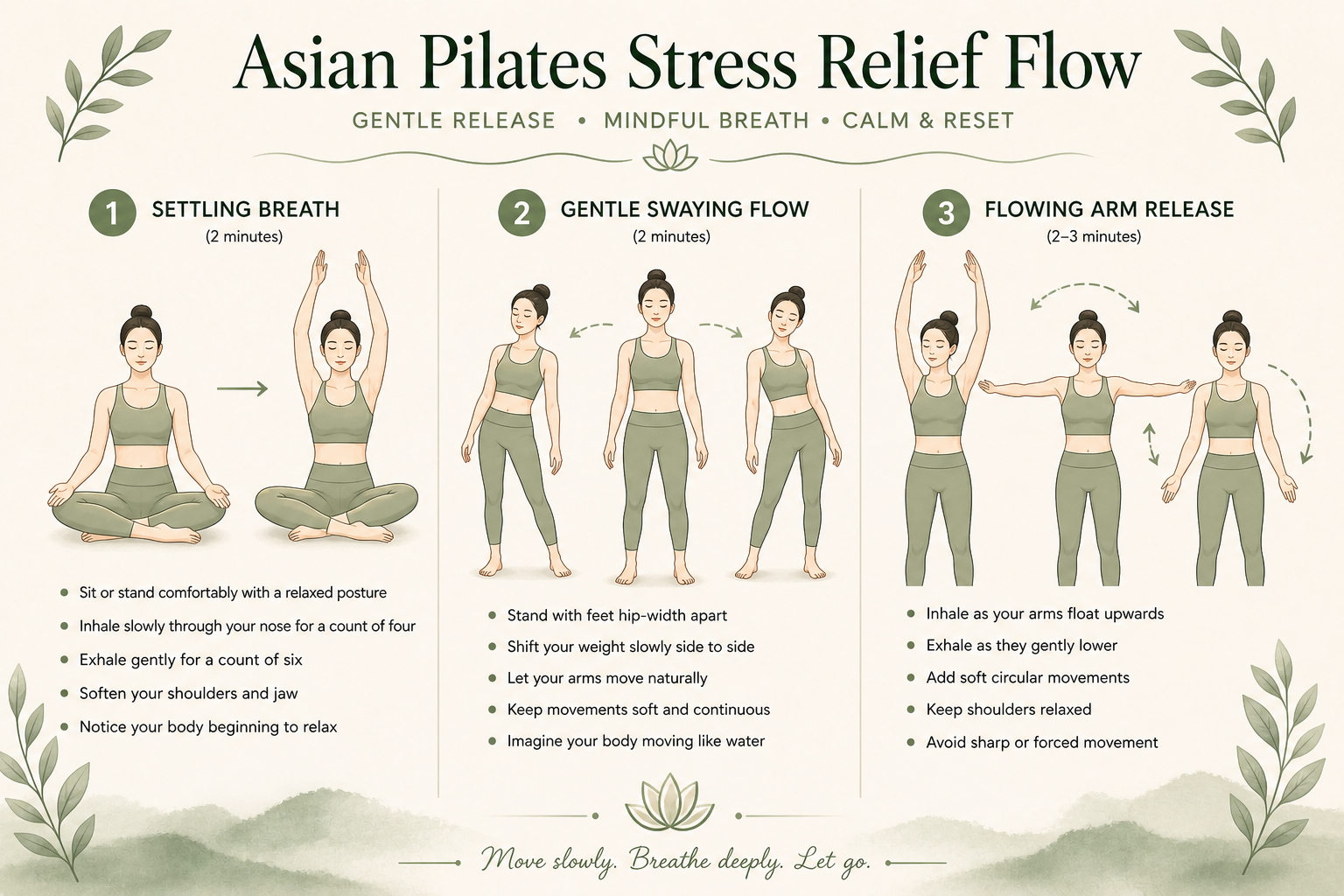
1. Settling Breath & Body Scan (2 minutes)
Begin standing or seated comfortably.
- Close your eyes if it feels safe
- Inhale through your nose for 4
- Exhale slowly for 6
As you breathe, gently scan your body from head to toe.
Notice:
- Jaw tension
- Shoulder tightness
- Any areas holding stress
Let your exhale soften these areas.
2. Gentle Swaying Flow (2 minutes)
Stand with feet hip-width apart.
- Slowly shift your weight side to side
- Let your arms follow naturally, loose and soft
Imagine your body moving like water.
This Tai Chi–inspired motion helps:
- Release physical tension
- Improve circulation
- Calm the mind
3. Flowing Arm Release (2–3 minutes)
Continue standing.
- Inhale as your arms float up
- Exhale as they drift down and slightly behind you
Add gentle circular movements.
Keep it:
- Soft
- Continuous
- Effortless
Let your shoulders drop and relax.
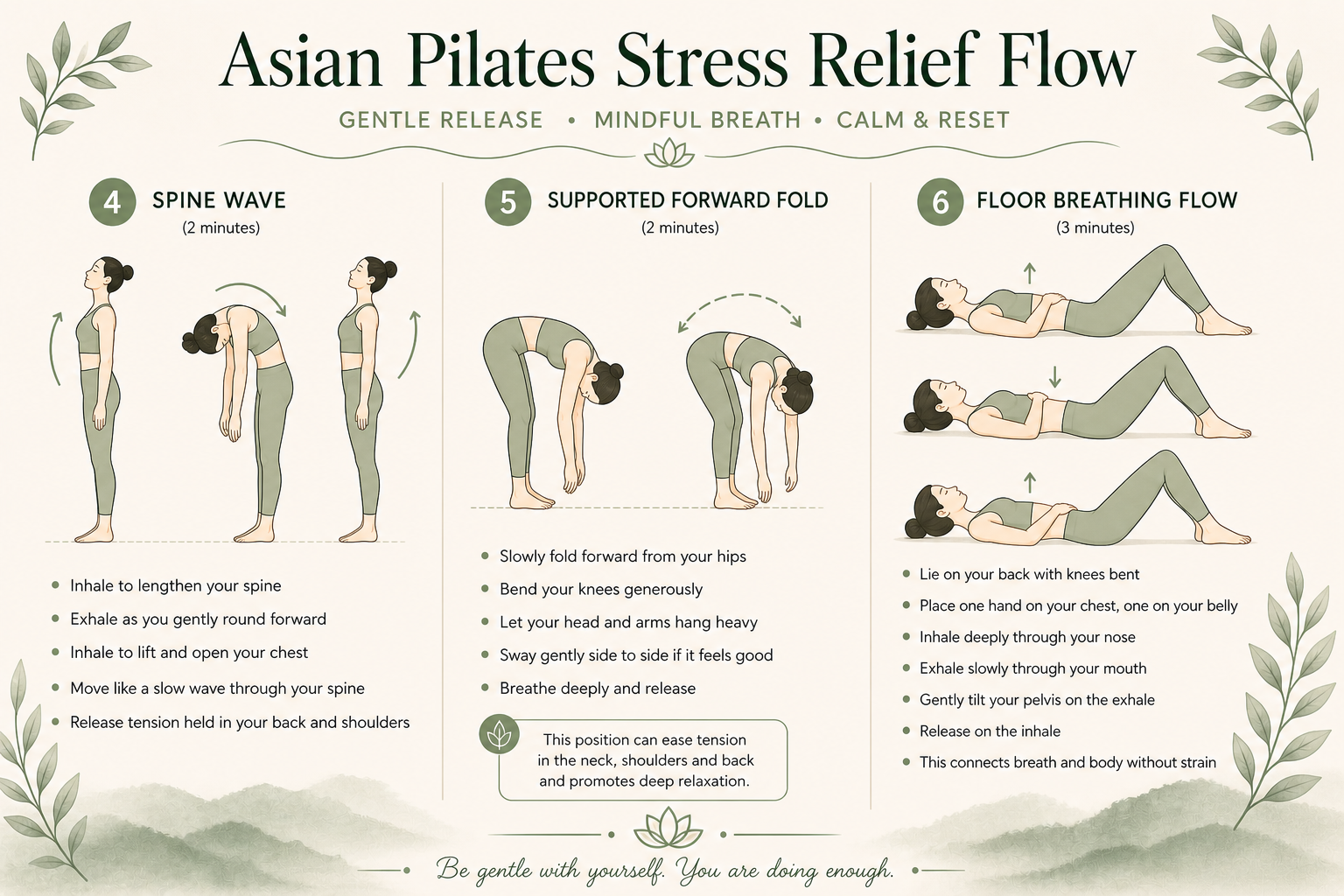
4. Spine Wave (2 minutes)
Stand tall.
- Inhale to lengthen your spine
- Exhale as you gently round forward
- Inhale to lift and open the chest
Move like a slow wave through your spine.
This helps release:
- Back tension
- Emotional stress held in posture
5. Supported Forward Fold (2 minutes)
Slowly fold forward from standing.
- Bend your knees generously
- Let your head and arms hang
Sway gently side to side if it feels good.
This position can:
- Ease neck and shoulder tension
- Promote relaxation through gravity
6. Floor-Based Breathing Flow (3 minutes)
Lie on your back, knees bent.
- Place one hand on your chest, one on your belly
- Inhale deeply through your nose
- Exhale slowly through your mouth
Add a gentle movement:
- Slight pelvic tilt on the exhale
- Release on the inhale
This connects breath and core without strain.
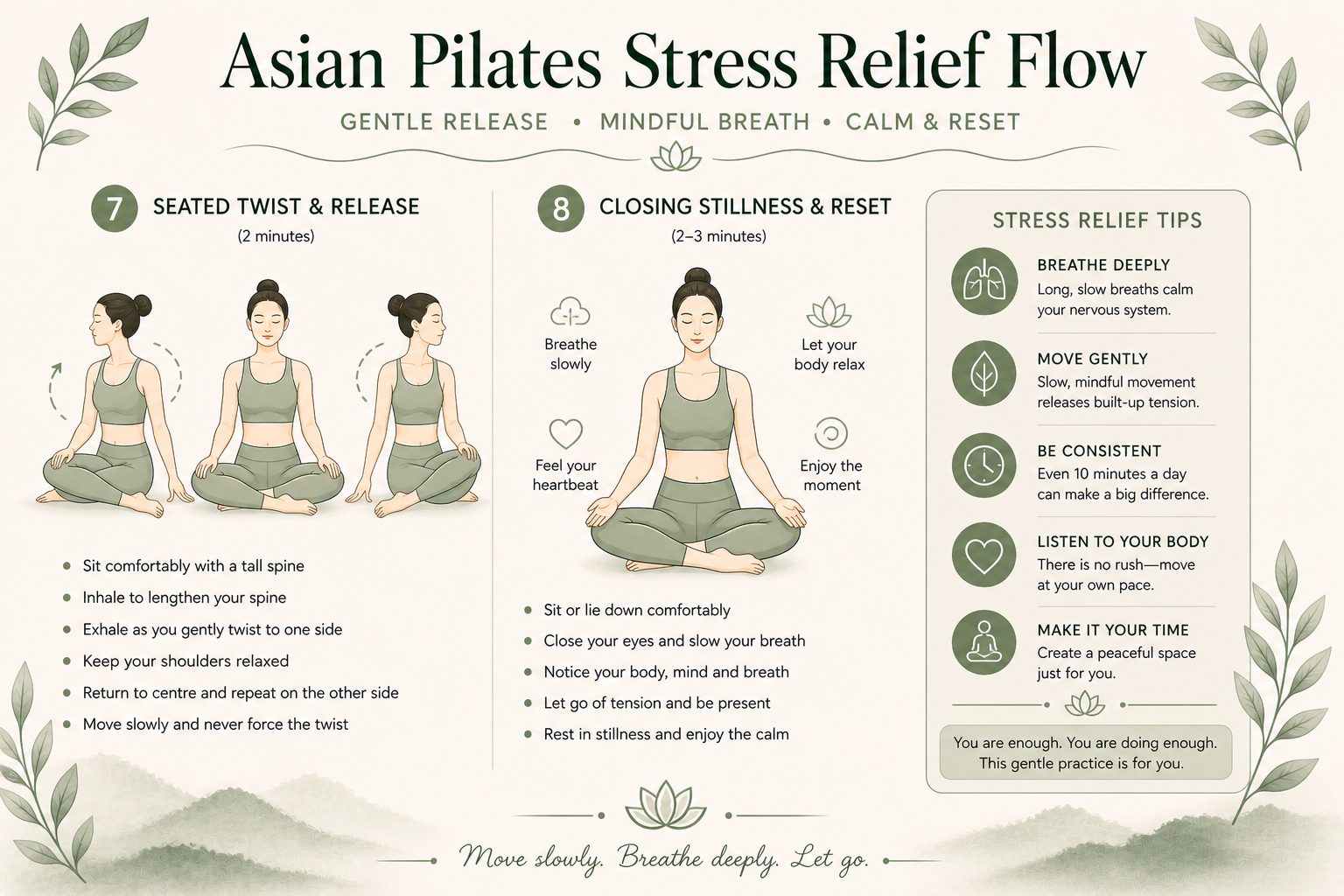
7. Seated Twist & Release (2 minutes)
Sit comfortably.
- Inhale to lengthen your spine
- Exhale into a soft twist
Keep it light—no forcing.
Imagine “wringing out” tension gently from your body.
8. Closing Stillness & Reset (2–3 minutes)
Finish seated or lying down.
- Slow your breath
- Let your body become still
Notice:
- Your heartbeat
- Your breath
- The feeling of calm
Stay here for a moment—this is where the real reset happens.
What Do Experts Say? (PubMed & NHS)
Although “Asian Pilates” as a term is new, its elements are well supported:
- Research from PubMed shows Pilates improves posture, reduces pain, and enhances body awareness
- The NHS highlights that regular gentle exercise can reduce stress, improve mood, and support better sleep
- Mindful movement practices (like Tai Chi) are also linked to improved mental wellbeing and relaxation
Together, these findings strongly support the benefits of this type of flow-based, low-impact exercise.
The Asian Pilates Stress Relief Flow is not about pushing your body—it’s about listening to it.
By combining gentle movement, flowing transitions, and mindful breathing, this routine helps shift your body out of stress mode and into a state of calm and balance.
Even a short session can leave you feeling lighter, more centred, and better able to handle the day ahead.
⚠️ Safety Note
Move within your comfort zone and avoid pain or discomfort.
If you have any injuries or medical conditions, consult a qualified professional before starting a new exercise routine.
❓ FAQ: Asian Pilates Stress Relief Flow
Is this routine suitable for beginners?
Yes, it’s gentle and adaptable—perfect even if you’re new to movement.
How often should I practise?
2–4 times per week, or whenever you feel stressed or overwhelmed.
Can it help with anxiety?
It may help reduce symptoms by calming the nervous system through breath and slow movement.
Do I need equipment?
No—just a mat or comfortable surface.
Is it similar to meditation?
Yes, it’s often described as a form of moving meditation.
Can I do it in the evening?
Absolutely—this flow is especially helpful before bed.
This content is for educational purposes and does not replace medical advice…
Some useful links:
30 min beginner Pilates workout
20 min full body Pilates workout
28-day Asian Pilates Challenge
BOOK: Ariel Qiren Chen:
About the author
Lilla Fonyo is a healthy lifestyle and longevity writer with a background in endurance running, nutrition, and mindful living. She focuses on sustainable habits that support long-term physical and mental wellbeing.
Sources:
www.nhs.uk - Benefits of exercise
www.pubmed.ncbi.nlm.nih.gov - Effects of Pilates on Body Posture: A Systematic Review
www.health.harvard.edu - The health benefits of tai chi
www.who.int - WHO guidelines on physical activity and sedentary behaviour